Download Corporate Calendar 2026 Download
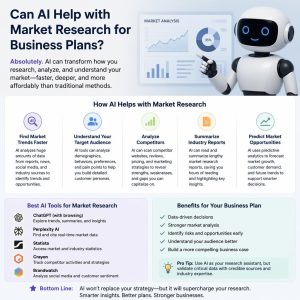
Market research is the foundation of every solid business plan. It answers the hard questions: Who are your customers? What are competitors doing? How big is the opportunity? But traditional market research is slow, expensive, and often overwhelming for entrepreneurs and small business owners.
Enter artificial intelligence.
In 2026, AI has moved from buzzword to business essential. Tools powered by large language models (LLMs), natural language processing (NLP), and machine learning can now analyse market data, identify trends, and generate insights in minutes — tasks that used to take weeks and cost thousands of dollars.
But can AI really replace traditional market research? What are its limits? And how do you integrate it into a professional business plan that investors will take seriously?
This article answers those questions with practical, hands-on techniques — including Python code you can run yourself.
Why Market Research Matters for Business PlansBefore diving into AI, let’s be clear on what market research needs to accomplish in a business plan:
A business plan without solid answers to these questions is a gamble. Investors see through thin research immediately. But doing this research properly — surveys, focus groups, industry reports, manual competitor audits — is a full-time job. Most startups and SMEs don’t have the budget.
AI changes the equation.
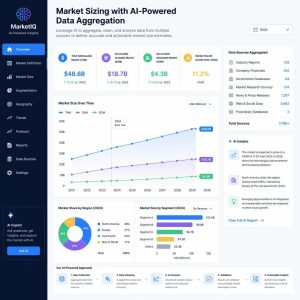
Traditional market sizing requires buying expensive industry reports from firms like Gartner, IBISWorld, or Statista — often 2,000to2,000 to 2,000to10,000 per report. AI tools can now aggregate publicly available data, government statistics, news articles, and industry publications to estimate market size.
Here’s a practical Python example using OpenAI’s API to estimate TAM for a hypothetical industry:
import openai
def estimate_market_size(industry: str, region: str) -> str:
"""Use AI to estimate market size from public data synthesis."""
prompt = f"""
You are a market research analyst. Based on publicly available data,
estimate the Total Addressable Market (TAM) for {industry} in {region}.
Provide:
1. Estimated TAM in USD
2. Annual growth rate (CAGR)
3. Key growth drivers
4. Data sources you would reference
5. Confidence level (Low/Medium/High)
Be transparent about limitations.
"""
response = openai.chat.completions.create(
model="gpt-4o",
messages=[{"role": "user", "content": prompt}]
)
return response.choices[0].message.content
# Example usage
result = estimate_market_size("electric vehicle charging", "Southeast Asia")
print(result)
This approach gives you a directional estimate — not a replacement for paid reports, but a strong starting point for early-stage business plans and pitch decks.
What AI does well: Synthesises publicly available data quickly. Good for top-down estimates and identifying growth trends.
What AI does poorly: Cannot access proprietary data or conduct primary research. Always cross-reference AI estimates with at least one human-verified source.
Understanding your customer is the heart of any business plan. AI-powered NLP tools can analyse customer reviews, social media conversations, and forum discussions to build detailed customer personas.
Here’s how to build a simple customer sentiment analyser using Python:
from transformers import pipeline
def analyse_customer_sentiment(reviews: list) -> dict:
"""Analyse customer sentiment from a list of reviews."""
sentiment_pipeline = pipeline(
"sentiment-analysis",
model="distilbert-base-uncased-finetuned-sst-2-english"
)
results = {"positive": 0, "negative": 0, "neutral": 0}
for review in reviews:
# Truncate long reviews
truncated = review[:512]
result = sentiment_pipeline(truncated)[0]
label = result["label"].lower()
results[label] = results.get(label, 0) + 1
total = len(reviews)
return {
"breakdown": results,
"positive_pct": round(results["positive"] / total * 100, 1),
"negative_pct": round(results["negative"] / total * 100, 1)
}
# Example: analysing competitor product reviews
sample_reviews = [
"The charging speed is incredible, best purchase this year.",
"Customer support was unhelpful and slow to respond.",
"Good value for money, but the app needs improvement.",
"Absolutely love this product, highly recommend.",
"Stopped working after 3 months. Very disappointed."
]
report = analyse_customer_sentiment(sample_reviews)
print(f"Positive: {report['positive_pct']}%")
print(f"Negative: {report['negative_pct']}%")
Practical application: Scrape competitors’ Google Reviews, Amazon reviews, or Trustpilot feedback. Run sentiment analysis to identify common pain points — these are your market opportunities.
Manually researching 10–20 competitors takes days. AI can do it in minutes. Modern LLMs can extract structured data from competitor websites: pricing, features, target audience, value propositions, and even SWOT elements.
Here’s a practical workflow:
import requests
from bs4 import BeautifulSoup
import openai
def extract_competitor_insights(url: str) -> str:
"""Scrape and analyse a competitor's website using AI."""
# Step 1: Scrape the page content
response = requests.get(url, timeout=10)
soup = BeautifulSoup(response.text, "html.parser")
# Extract visible text (strip scripts, styles)
for tag in soup(["script", "style", "nav", "footer"]):
tag.decompose()
text = soup.get_text(separator="\n", strip=True)
# Truncate to avoid token limits
text = text[:8000]
# Step 2: Ask AI to extract structured insights
prompt = f"""
Analyse the following competitor website content and extract:
1. Company name and tagline
2. Products/services offered
3. Pricing model (if visible)
4. Target audience
5. Key differentiators
6. Apparent strengths
7. Apparent weaknesses or gaps
Website content:
{text}
"""
response = openai.chat.completions.create(
model="gpt-4o-mini",
messages=[{"role": "user", "content": prompt}]
)
return response.choices[0].message.content
# Example usage
insights = extract_competitor_insights("https://competitor-website.com")
print(insights)
Important caveat: Always verify AI-extracted data. LLMs can hallucinate pricing details or misread product offerings. Treat AI competitor analysis as a first draft that needs human validation.
For a business plan to be convincing, you need to show that you understand where the market is heading. AI excels at identifying patterns in historical data and projecting trends forward.
While sophisticated forecasting requires dedicated ML pipelines, even simple Python can deliver useful insights:
import pandas as pd
import matplotlib.pyplot as plt
from sklearn.linear_model import LinearRegression
import numpy as np
def forecast_market_trend(data: list, periods_ahead: int = 12):
"""Simple linear regression forecast for market trends."""
# Create dataframe
df = pd.DataFrame(data, columns=["period", "value"])
df["period_num"] = range(len(df))
# Train model
X = df<a href=""period_num".md" class="wikilink" data-broken="1">"period_num"</a>.values
y = df["value"].values
model = LinearRegression()
model.fit(X, y)
# Forecast
future_periods = np.arange(len(df), len(df) + periods_ahead).reshape(-1, 1)
forecast = model.predict(future_periods)
print(f"Trend: {'Upward' if model.coef_[0] > 0 else 'Downward'}")
print(f"Growth rate: {model.coef_[0]:.2f} units per period")
print(f"R²: {model.score(X, y):.2f}")
return forecast
# Example: monthly revenue data
data = [
("2025-01", 10000), ("2025-02", 10500), ("2025-03", 11200),
("2025-04", 10800), ("2025-05", 12000), ("2025-06", 12500),
("2025-07", 13100), ("2025-08", 12800), ("2025-09", 14000),
("2025-10", 14500), ("2025-11", 15000), ("2025-12", 15800),
]
forecast = forecast_market_trend(data, periods_ahead=6)
print(f"Next 6 months forecast: {forecast}")
For more advanced forecasting, explore tools like Facebook Prophet, Amazon Forecast, or GPT-4’s ability to analyse and explain time-series patterns in natural language.
5. Real-World Case Study: AI Market Research in ActionLet’s look at a concrete example. Consider a Singapore-based entrepreneur planning to launch a sustainable packaging business targeting F&B outlets.
Traditional approach (2–4 weeks, 5,000–5,000–5,000–15,000):
AI-augmented approach (2–3 days, under $100):
Market sizing (30 minutes): Use ChatGPT or Perplexity to estimate Singapore’s sustainable packaging market — cross-referencing NEA data, industry publications, and news articles. Result: a directional TAM estimate of $80–120 million SGD with 12% CAGR.
Competitor landscape (2 hours): Scrape 15 competitor websites. Use the Python script from Section 3 to extract pricing, positioning, and product lines. Map them on a 2×2 matrix (premium vs budget, broad vs niche).
Customer discovery (1 day): Draft a survey using AI-generated questions. Distribute via WhatsApp to 50 F&B contacts. Feed open-ended responses into the sentiment analyser from Section 2. Top pain point identified: “current suppliers have 4-week lead times — we need faster turnaround.”
Trend analysis (1 hour): Use Google Trends plus AI trend synthesis. Key insight: searches for “compostable packaging Singapore” grew 340% year-on-year, driven by the upcoming mandatory packaging reporting framework.
Business plan drafting (2 hours): Feed all findings into an LLM with clear instructions to structure the market research chapter. Edit for accuracy and add local nuance.
This isn’t hypothetical — it’s how savvy startups are operating in 2026. The quality is comparable to traditional research at 1% of the cost and 10% of the time.
The key is knowing what to ask and how to verify. AI accelerates the grunt work; your business judgment provides the signal from the noise.
Despite its power, AI has important limitations you must acknowledge in any business plan:
| Limitation | Why It Matters | Mitigation |
|---|---|---|
| Data recency | LLMs are trained on historical data; may miss the latest market moves | Supplement with human web research |
| Hallucination | AI can invent statistics, company names, or market figures | Verify every number; cite real sources |
| Lack of primary data | Cannot conduct surveys, interviews, or field research | Use AI to analyse primary data you collect yourself |
| Context blindness | AI doesn’t understand your local market dynamics (e.g., Singapore’s specific regulations) | Apply your own domain knowledge as a filter |
| Bias in training data | AI may reflect Western-centric market assumptions | Question all AI outputs critically |
Bottom line: AI is a research accelerator, not a replacement for human judgment. The best business plans use AI for speed and breadth, then layer human expertise for accuracy and depth.
Here is a practical, step-by-step workflow:
| Tool | Use Case | Cost |
|---|---|---|
| ChatGPT / Claude | General market analysis, competitor profiling, report drafting | Free–$20/month |
| Perplexity AI | Real-time web research with citations | Free–$20/month |
| Google Trends | Search volume analysis and trend comparison | Free |
| Python + HuggingFace | Custom sentiment analysis, NLP pipelines | Free (open source) |
| SimilarWeb | Website traffic and competitor benchmarking | Free tier available |
| Statista / IBISWorld | Verified industry statistics (AI supplements, doesn’t replace) | Paid |
https://www.cbs.com.sg/can-ai-help-with-market-research-for-business-plans-yes-heres-how/
copy