Download Corporate Calendar 2027 Download

 13 minutes

AI communication techniques help people communicate with AI systems and communicate through AI assisted tools. The first involves giving an AI model clear instructions. The second involves using AI to draft, simplify, translate, personalize, or test messages for real people. Both require more than polished wording. They require context, judgment, and a reliable review process.
For professionals, managers, educators, and public communicators, the goal is not to make every message sound automated. It is to produce communication that is accurate, understandable, appropriate for the audience, and clear about what happens next. I use AI communication techniques as a structured way to reach that goal while keeping human accountability in place.
AI communication techniques are methods for improving how an AI system receives, interprets, creates, and supports messages. They include instruction design, context grounding, tone control, clarification, audience modeling, message testing, and human review.
The key distinction is simple but useful: communication with AI is an interaction between a person and a system, while AI mediated communication is communication between people that AI helps create or transform. A research article from Springer describes this distinction as communication between humans and AI versus communication mediated by AI. The difference matters because each activity has different risks.
When communicating directly with an AI model or conversational agent, the main task is to reduce uncertainty. The AI does not automatically know your organization’s history, the recipient’s concerns, or which facts are approved. It predicts a useful response from the information it receives.
A vague request such as, “Write an email about the new policy,” leaves too many decisions open. The model may choose the wrong audience, omit a required action, assume unsupported details, or use a tone that feels overly formal.
A stronger instruction makes those decisions visible:
Draft a 180 word email to employees about a revised travel expense process. Use a calm and practical tone. Explain the effective date, the two required actions, and where questions should go. Do not add policy details not included below.
This is not merely a longer request. It defines the communication task: recipient, subject, tone, constraints, action, and factual boundary.
AI mediated communication begins with a human message but uses AI to change its form. For example, an HR team may convert a policy update into a manager briefing, employee FAQ, plain language summary, and short intranet post. A technical team may turn a cybersecurity notice into a version for nontechnical staff.
This use is especially valuable when one message must work across different levels of knowledge. For a broader overview of these practical uses, see The Complete Guide to Smarter Conversations.
The risk is that the AI may preserve the words while changing the meaning. “Simplify this legal notice” can result in a readable draft that accidentally removes an exception, deadline, or condition. For that reason, plain language translation should preserve the decision a reader needs to make, not just shorten the sentence.
AI can produce confident, professional prose even when the underlying content is incomplete or wrong. Good style is not evidence of factual accuracy. In fact, polished wording can make weak claims harder to spot because the reader is less likely to question them.
Treat fluency and reliability as separate checks. A message may be clear but inaccurate. It may be accurate but unsuitable for its audience. It may be both accurate and suitable yet fail because it does not tell people what to do.
That is why effective AI communication is a decision process, not a one step drafting task.
The most dependable instructions create a shared working brief. Rather than asking AI to “make this better,” identify what better means in this situation.
Before generating a draft, provide the inputs that affect the answer. A useful brief can be organized into six parts:
| Brief Element | What To Specify | Why It Changes The Output |
|---|---|---|
| Audience | Role, knowledge level, likely concerns | Determines language and detail |
| Objective | Inform, request, explain, persuade, deescalate | Keeps the message focused |
| Evidence | Approved facts, source text, data, dates | Reduces unsupported assumptions |
| Desired action | What readers should do and by when | Makes the message actionable |
| Channel | Email, presentation, chat, notice, script | Shapes length and structure |
| Constraints | Tone, reading level, prohibited claims, length | Prevents unsuitable output |
A prompt can then ask the AI to identify missing information before writing. For example: “If any fact needed to complete this message is absent, ask up to three clarification questions. Do not guess.” This changes the model’s role from eager drafter to cautious collaborator.
A conversational AI agent should listen to the input, reason about its meaning, and respond clearly. That expectation is reflected in PolyAI’s description of an AI agent. In practical terms, a useful system should not only generate text. It should recognize uncertainty, identify missing details, and support the next step in the conversation.
Tone instructions work best when they describe behavior, not only adjectives. “Professional but friendly” is often too broad. Instead, state what the reader should experience and what language to avoid.
For example, a manager writing about a process delay might ask for:
• A direct opening that acknowledges the delay
• Short paragraphs and no jargon
• A clear explanation of what is known and unknown
• No promises about dates that have not been confirmed
• A respectful invitation for questions
This gives the AI observable boundaries. It also makes editing easier because the writer can check whether each boundary was followed.
Tone control becomes more important when the same issue requires several versions. A compliance reminder may need a supportive first notice, a firm follow up, and a formal final escalation. The factual core should remain stable while urgency, directness, and consequences change.
Examples can help establish a preferred pattern. If you want a short executive summary, provide one that demonstrates the desired structure: issue, business impact, decision required, and deadline.
Fair warning: examples can also anchor the AI too tightly. If your sample includes outdated terminology or a communication style that does not fit the new audience, the model may repeat those weaknesses. Use examples as a style guide, not as unquestioned source material.
For practical workplace applications, Enhancing Connectivity and Efficiency with AI explores how AI can support faster and more connected communication processes.
A strong first instruction is useful, but it does not remove the need for repair. AI communication works best as a conversation in which misunderstandings are detected early and corrected precisely.
When an AI response is wrong, avoid replying only with “Try again.” Identify the type of failure. Different failures need different corrections.
| Failure Pattern | Likely Cause | Repair Instruction |
|---|---|---|
| Wrong facts | Missing or conflicting source material | “Use only the attached policy text. Remove unsupported claims.” |
| Generic wording | Weak audience or purpose definition | “Write for new supervisors who need a practical next step.” |
| Wrong tone | Tone terms were vague or contradictory | “Use calm, plain language. Avoid sales language and exclamation marks.” |
| Missing action | No action or deadline was supplied | “End with the required action, owner, and due date.” |
| Excessive detail | No length or priority limit | “Keep only information needed for a two minute read.” |
Research on strategic communication identifies repair behaviors such as clarification, confirmation, repetition, paraphrase, and self monitoring. These are described in an ERIC hosted study of AI generated communication strategies. The lesson is practical: do not treat misunderstanding as a failed prompt. Treat it as a signal to clarify the shared task.
Useful repair questions include:
Singapore workplaces often include people with different first languages, cultural references, professional roles, and levels of comfort with formal English. AI can help create versions for different audiences, but adaptation should not become stereotyping.
Start with communication needs, not assumptions about identity. A frontline employee may need a short step by step notice. A department head may need operational impact, risk, cost, and decision points. A public audience may need plain language, translated terms, and clear contact options.
Ask the AI to identify potentially unclear idioms, unexplained acronyms, culturally loaded phrasing, and assumptions about prior knowledge. Then have a human reviewer assess whether the message still sounds respectful and natural.
Singapore government communication teams have used AI personas grounded in audience research to identify blind spots and refine announcements. The approach is valuable because it makes audience reactions part of the drafting process. It should not be treated as proof of what real people will think. The same government example presents persona testing as a complement to direct focus groups, not a substitute for them.
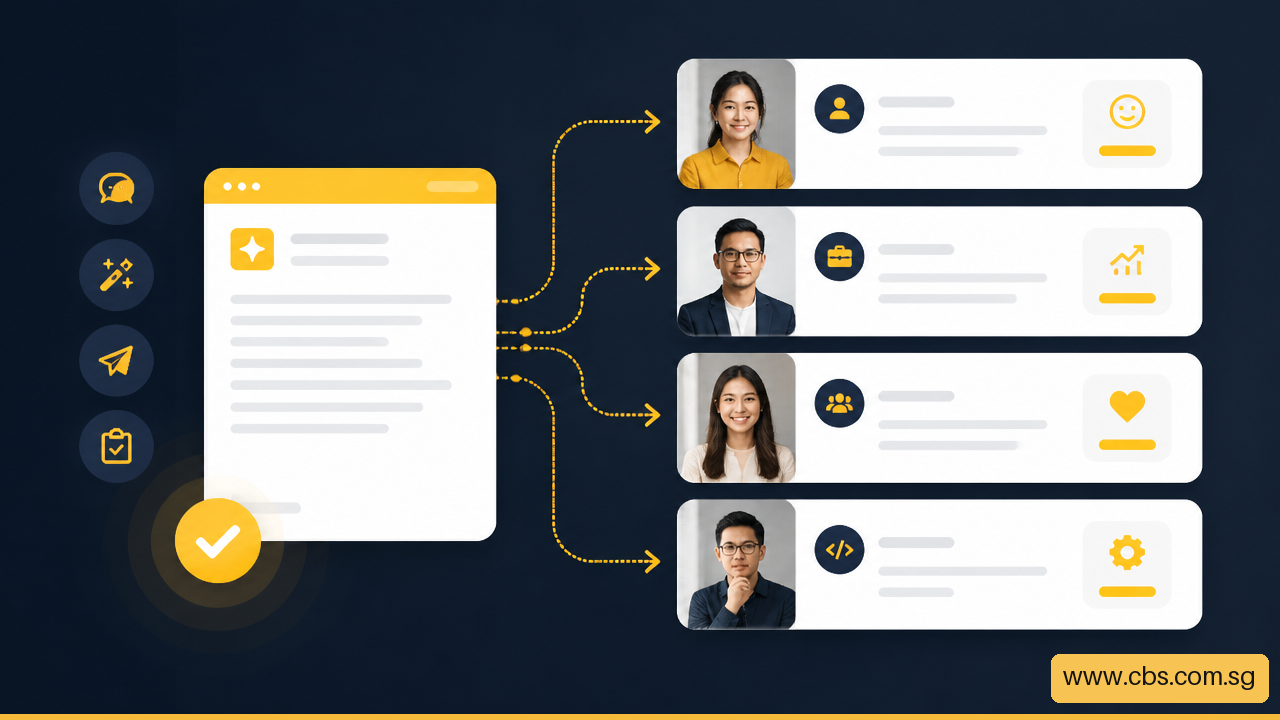
Message stress testing asks, “How could this be misunderstood, resisted, or ignored?” It is especially useful for policy changes, service disruptions, safety instructions, and employee updates.
Create a small set of audience perspectives based on real communication needs. For example:
• A busy employee who reads only the first paragraph
• A manager who needs to explain the change to a team
• A customer affected by the change but unfamiliar with internal terms
• A skeptical recipient looking for hidden costs or consequences
Ask the AI to review the draft from each perspective. Then verify the concerns with people who understand the audience. This sequence is efficient because the AI can flag possible problems quickly, while humans decide which concerns are real and which revisions are appropriate.
The question is not whether AI produces a draft faster. The question is whether it improves the final communication without creating unacceptable risk.
A measurable rubric prevents teams from approving text simply because it “sounds good.” Score each category from 1 to 5 before and after editing.
| Quality Check | Review Question | Warning Sign |
|---|---|---|
| Accuracy | Are names, dates, numbers, and claims verified? | A specific fact has no approved source |
| Comprehension | Can the intended audience explain the message? | Readers ask what the message means |
| Actionability | Is the required next step obvious? | The message informs but does not guide |
| Tone Fit | Does the language match the relationship and situation? | It sounds cold, inflated, or overly casual |
| Inclusion | Is the wording accessible and free of avoidable assumptions? | Acronyms, idioms, or jargon block understanding |
| Editing Burden | Did AI reduce work after review? | Rewriting takes longer than drafting manually |
There is no universal benchmark showing what score proves an AI assisted message is successful. A team should establish its own baseline. For instance, compare an AI assisted employee email with a human drafted version by asking a small review group what action they believe is required. If the AI version is faster to create but generates more questions, the apparent efficiency may be false.
AI should not be the final decision maker for communication that is confidential, legally consequential, emotionally sensitive, politically sensitive, or likely to affect a person’s safety, employment, rights, or reputation.
Use added caution when a message involves:
• Personal data, medical information, investigations, or security incidents
• Legal commitments, disciplinary action, contracts, regulatory requirements, or financial consequences
• Grief, mental health, harassment, conflict, or crisis communication
• Public statements that could damage trust if facts change
In these cases, AI can still help with structure, readability, question lists, and alternative wording. However, an accountable human should verify facts, context, authority, and final tone before release.
A review pass should examine names, dates, figures, claims, unnatural wording, and missing human context before a message is used. A pre send review checklist for AI generated communication is particularly important because the most credible sounding draft can still contain an unsupported assumption.
For routine, low risk messages, a simple workflow may be enough:
For higher risk communication, add subject matter review, privacy checks, legal or policy approval where relevant, and audience testing. The required effort should match the consequence of being wrong.
If you want to deepen the drafting side of this workflow, Master AI Writing Tools offers a useful next step for Singapore professionals working with AI writing systems in 2026.
• AI communication techniques cover both direct interaction with AI and AI assisted communication between people.
• The best instructions define audience, objective, evidence, action, channel, and constraints before drafting begins.
• When output misses the mark, diagnose the failure type instead of repeatedly asking the AI to rewrite.
• Persona based testing can reveal possible audience blind spots, but it does not replace direct feedback from real people.
• Evaluate messages for accuracy, comprehension, actionability, tone fit, inclusion, and editing burden.
• Keep humans accountable for high stakes communication involving privacy, safety, legal consequences, sensitive emotions, or public trust.
AI communication techniques are practical methods for improving interaction with AI systems and AI assisted messages. They include clear instruction design, context grounding, tone control, clarification questions, communication repair, audience adaptation, stress testing, and human review.
Include the audience, objective, approved facts, desired action, communication channel, length, tone, and constraints. If information is missing, instruct the AI to ask clarifying questions rather than make assumptions.
Give the AI details that only your situation can provide: the reader’s likely concern, the decision they need to make, the consequences of delay, required terminology, and examples of acceptable language. Then edit out vague openings, broad claims, and unnecessary filler.
Name the specific problem. For example, say, “You used an unconfirmed deadline,” or “This is written for executives, but the audience is frontline staff.” Ask the AI to restate the revised task before generating another draft.
Yes. AI can create versions for leaders, employees, customers, or technical specialists. Review each version to ensure that simplification does not remove essential conditions, risks, or actions.
A human should review all external, important, or consequential messages. Human review is essential when the content includes confidential data, legal or financial impact, sensitive personal matters, public announcements, or safety information.
Ask AI to flag jargon, idioms, unexplained assumptions, and potentially unclear phrasing for the intended audience. Use audience personas as an early screen, then seek feedback from actual representatives of the audience when the stakes justify it.
Compare AI assisted and non AI drafts using practical indicators: reader comprehension, number of follow up questions, correction rate, time to approval, completion of the requested action, and stakeholder feedback. Faster drafting alone is not enough.


https://www.cbs.com.sg/ai-communication-techniques-for-clearer-safer-messages/
copy

