Download Corporate Calendar 2027 Download

 15 minutes

What are the latest AI threats to watch out for? The most serious risks are no longer limited to inaccurate chatbot answers. AI can now be connected to email, business data, payment systems, code tools, customer records, and other AI agents. That creates a larger problem: a manipulated AI system may not just provide bad information. It may expose data, take unauthorized action, or help an attacker move through connected systems.
The practical question is not whether an organization uses generative AI. It is what the AI can access, what it can change, and how quickly mistakes can spread. A chatbot that summarizes public documents has a limited blast radius. An autonomous assistant that can search private files, send emails, approve purchases, or run code has far more to protect.
The most urgent AI threats combine a familiar weakness, such as social engineering or poor access control, with new automation. Attackers do not need to “break” a model in a dramatic way. Often, they only need to influence what an AI reads, exploit permissions it already has, or persuade a person to trust a realistic fake.
The OWASP 2025 risk taxonomy for LLM and generative AI applications defines major application layer threats including prompt injection, sensitive information disclosure, supply chain risk, data and model poisoning, unsafe output handling, excessive agency, vector and embedding weaknesses, misinformation, and unbounded consumption. These risks overlap. That is why treating them as isolated technical issues can leave important gaps.
Prompt injection happens when attacker controlled content causes an AI application to follow instructions that conflict with its intended purpose. A malicious instruction might be hidden in a webpage, document, support ticket, calendar invitation, or file that an AI assistant is asked to read.
Consider a travel planning assistant with access to an employee’s email and calendar. It may browse a webpage that includes hidden instructions telling it to search for confidential files or forward information elsewhere. The model does not need to “understand” that it is being attacked. It only needs to treat hostile text as relevant instructions.
The immediate risk depends on connected tools. If the assistant can only summarize content, the likely result may be a misleading answer. If it can send emails, access customer records, or execute code, the same manipulation could lead to an unauthorized action.
This is where improper output handling becomes dangerous. An AI generated response should not be passed directly into a database query, shell command, browser automation step, or payment workflow without validation. A model can produce text that looks plausible but contains unsafe instructions, malformed commands, or attacker selected values.
Deepfakes are synthetic images, video, or audio designed to appear authentic. Voice cloning can make a caller sound like a manager, family member, colleague, or public official. These threats matter because people often make rapid decisions when a message sounds urgent, private, or authoritative.
A convincing voice message asking finance staff to change bank details is not only a media problem. It is an identity and process problem. The most reliable defense is to require independent verification for sensitive changes, using a known number, a separate approval channel, or a documented workflow.
For individuals, caution is equally important. Do not rely on a voice, video call, familiar profile photo, or apparent urgency as proof of identity. A short delay to verify can prevent a costly mistake. Practical awareness programs such as Cybersecurity in Your Pocket: Outsmart Deepfakes and AI Threats can help employees recognize the social engineering patterns behind synthetic media scams.
AI data leakage is not limited to someone deliberately pasting a confidential file into a public chatbot. It can also occur when an internal assistant retrieves information that the current user should not see, includes sensitive content in its answer, or passes private data to a connected service.
Retrieval augmented generation, often called RAG, lets an AI retrieve documents before answering. This improves usefulness, but it adds a new security boundary: the documents, permissions, search index, embeddings, and retrieval logic all need protection.
A poisoned document can exploit this process. For example, an attacker may insert misleading instructions into a file that is later indexed in a knowledge base. If that content ranks highly in retrieval, the AI could repeat false information, expose misleading guidance, or follow unwanted instructions. The risk becomes more serious where documents from different teams, customers, or tenants are stored in the same environment.
The Trend Micro explanation of the OWASP LLM risks describes how poisoning can affect training, fine tuning, and embedding stages, potentially introducing bias, vulnerabilities, or degraded performance. In practice, organizations should test whether one user can retrieve another group’s documents and whether untrusted material can outrank approved sources.
A hallucination is an AI output that is inaccurate or invented. Misinformation is false or misleading information, whether accidental or deliberate. Disinformation is misinformation created or shared with the intent to deceive. The distinction matters because each needs a different response.
A hallucinated policy summary may be an accuracy failure. A fake news item generated to influence public opinion is disinformation. A deliberately altered internal document that causes a support bot to mislead customers may involve both manipulation and misinformation.
High stakes decisions require human review and reliable source checking. This is especially true for medical, legal, financial, hiring, disciplinary, and safety related uses. An AI response can be a starting point, not final evidence.
Model extraction is another concern for organizations that build valuable AI services. Attackers may repeatedly query a model to learn how it behaves, reproduce its capabilities, discover weaknesses, or collect patterns that support later abuse. The Palo Alto Networks overview of AI security concerns includes model extraction, authentication weaknesses, insufficient monitoring, information disclosure, and supply chain vulnerabilities among current areas of concern.
AI agents differ from ordinary chatbots because they can plan tasks, retain context, call tools, and act through software systems. An agent may search documents, draft a response, open a browser, submit a form, update a record, or ask another agent for help.
That can save time. It can also turn a small failure into a chain of failures.
I would assess an AI system by its connected capabilities, not by whether it is described as “smart” or “generative.” The relevant boundary includes the model, user identity, tools, application interfaces, data sources, memory, and approval process.
Connected Capability | Possible Failure | Appropriate Control |
|---|---|---|
Email access | Agent sends or forwards sensitive content | Require user confirmation before external sending |
Private document search | Cross team or cross tenant data exposure | Enforce retrieval permissions at query time |
Code execution | Unsafe command or dependency use | Use isolated environments and allowlisted actions |
Payment or purchasing tools | Unauthorized spending or vendor change | Apply spending limits and dual approval |
Long term memory | Harmful instructions persist across tasks | Review, expire, and segregate stored memory |
An AI tool with broad permissions may be convenient, but convenience can hide risk. A better design is to grant only the authority needed for a narrow task. A meeting assistant may need calendar read access, for example, but it probably does not need permission to send messages, edit financial data, or access every shared drive.
Long running agent systems may store memory so they can reuse preferences, past facts, task details, or prior instructions. This creates a persistence problem. If harmful content enters memory, it may influence later tasks long after the original interaction has ended.
The risk increases when several agents communicate. One agent may retrieve a poisoned document, summarize it as trustworthy, and pass it to another agent that has authority to take action. Each step can appear reasonable on its own. The combined chain is where damage occurs.
NIST’s material on emerging agentic security threats identifies tool misuse, privilege abuse, memory or context injection, insecure communication between agents, cascading failures, and human agent trust exploitation. The key lesson is simple: an agent architecture should be tested as a system, not merely as a model responding to one question.
Excessive agency occurs when an AI has too much autonomy, too many functions, or permissions beyond what a task requires. An agent should not be able to make irreversible decisions merely because it can technically call an API.
The OWASP guidance on agentic AI security risks identifies threats specific to agentic systems, including behavior hijacking, tool misuse, and identity or privilege abuse. These are not minor variations of chatbot errors. They involve authority.
A useful rule is to match controls to reversibility:
Do not assume a human approval button solves every problem. If the approval screen is vague, rushed, or presented by an untrusted agent, people may approve harmful actions without understanding the consequences. Clear summaries of _what will happen, which data will be used, and what cannot be undone_ are essential.
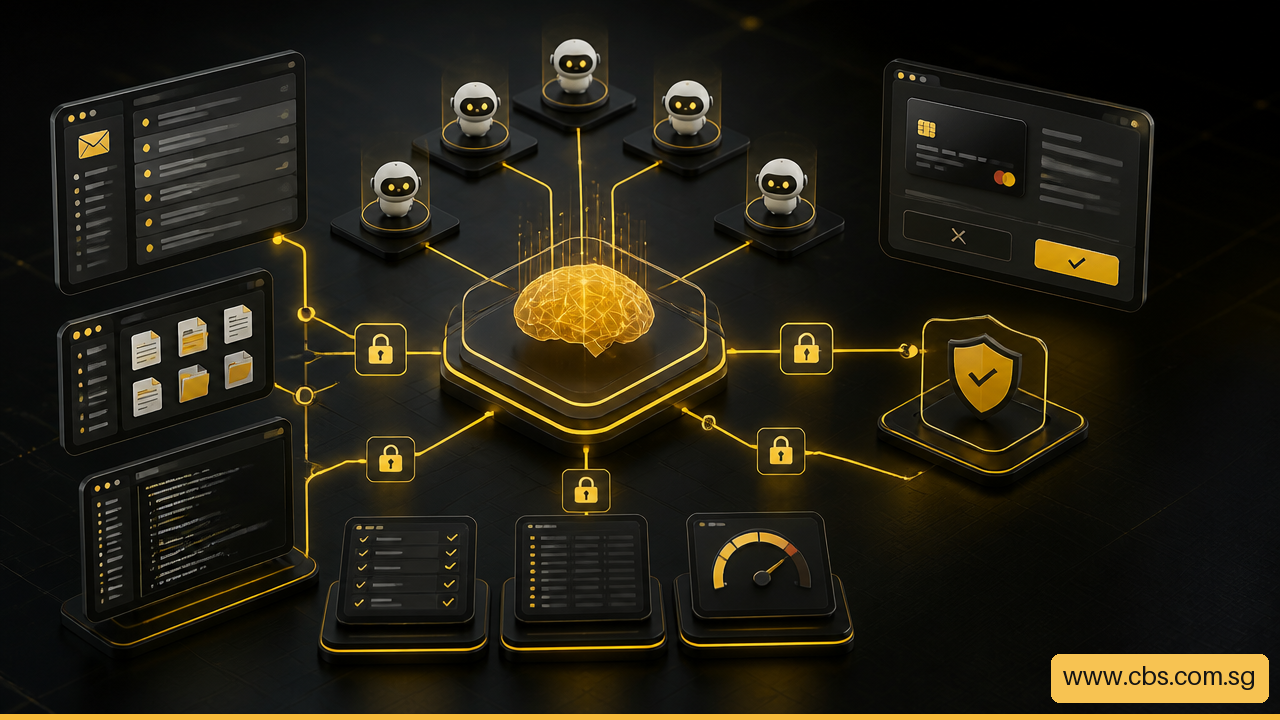
Effective AI security is not a ban on experimentation. It is a disciplined way to decide where automation is appropriate and where human control remains necessary. The first priority should be systems with sensitive data, write access, external communication capabilities, or autonomous tool use.
Before deploying or expanding an AI tool, document what it can read, write, send, execute, store, and share. Then ask what happens if its instructions, memory, or retrieved content are manipulated.
A simple review can use five questions:
Systems that score high on several questions need stronger controls before launch. A public writing assistant may need content review. A customer service agent connected to account data and refund tools needs identity controls, detailed logs, rate limits, testing, and escalation paths.
Security controls work best when they are designed into the product rather than added after a problem occurs.
• Separate identities and permissions. Give an AI agent its own narrowly scoped credentials. Do not let it silently inherit an administrator’s full access.
• Validate tool inputs and outputs. Treat AI generated commands, URLs, database requests, and code as untrusted until checked against rules.
• Enforce authorization during retrieval. A RAG system should verify whether the user is allowed to access each document before it is included in a response.
• Use trusted content tiers. Distinguish approved policies and curated knowledge from open web content, user uploads, and unverified documents.
• Set hard limits. Cap spending, token use, retries, tool calls, and task duration. This protects against denial of service, runaway loops, and unexpected cloud costs.
• Log meaningful events. Record tool calls, permission decisions, retrieved documents, external messages, approvals, and failures. Logs should support investigation, not simply collect large volumes of data.
• Test realistic attacks. Include malicious documents, indirect instructions, poisoned knowledge base entries, cross tenant access attempts, and misleading approval requests in pre deployment testing.
Unbounded consumption deserves special attention. A looping agent may repeatedly call models and tools while trying to solve a task it cannot complete. The result can be degraded service, a large bill, or both. Budget thresholds and circuit breakers are not merely finance controls. They are security controls.
If confidential information may have been entered into an AI service or exposed through an AI application, speed matters. Preserve the facts before changing systems or deleting evidence.
For Singapore based organizations, local privacy and cybersecurity duties should be considered alongside internal policies and contractual commitments. However, specific local prevalence figures for prompt injection, agent hijacking, or RAG attacks should not be assumed without verified local evidence. The technical risks are real; the local incident rate may be harder to establish.
AI adoption also needs workforce judgment. Understanding tools is useful, but users should know what information must stay out of public services, when an output needs verification, and how to recognize an AI generated message that demands urgent action. Responsible use belongs alongside productivity training such as Top 10 AI Tools for Work Productivity, not after it.
• The latest AI threats are increasingly about connected authority, not only inaccurate text generation.
• Prompt injection becomes far more serious when an AI can access email, documents, code, payments, or other tools.
• Agent systems can create compound attack paths involving memory injection, privilege abuse, tool misuse, and cascading failures.
• RAG applications need document provenance, retrieval authorization, tenant isolation, and testing for poisoned content.
• Deepfakes and voice clones exploit human trust, so sensitive requests need verification through an independent channel.
• The safest AI deployments limit permissions, use approval gates for high impact actions, log activity, and set strict usage limits.
• AI generated information should not be treated as final authority in medical, legal, financial, employment, safety, or disciplinary decisions.
AI will remain valuable when it is used with clear limits and informed oversight. Communication is one area where these tradeoffs are especially visible; AI Technology in Communication: The Ultimate Guide offers useful context on how AI is changing workplace interactions and information flows.
The most serious threats involve prompt injection, data leakage, deepfakes, poisoned retrieval content, unsafe tool use, excessive permissions, and autonomous agents that can take actions across connected systems. The highest priority depends on what the AI can access and change.
They can be. A standard chatbot usually produces text. An agent can use tools, retain memory, interact with APIs, and act on behalf of a user. That extra capability increases productivity but also expands the potential blast radius of a mistake or attack.
An attacker places instructions in content the AI reads, such as a webpage or document. If the AI treats those instructions as valid, it may ignore intended rules, reveal information, or misuse connected tools. Strong permission boundaries reduce the impact even if an injection succeeds.
Yes. It may expose information through poorly controlled retrieval, overly broad access permissions, shared conversation history, unsafe integrations, or direct user input into an unsuitable service. Organizations should classify data and restrict which systems can process sensitive content.
A hallucination is an inaccurate or fabricated AI output without a necessary intent to deceive. Disinformation is false information deliberately created or spread to mislead. Both can cause harm, but disinformation also requires investigation into intent, source, and distribution.
A poisoned document can be retrieved as context and influence the answer the chatbot gives. It may contain false facts, hidden instructions, or manipulated language designed to rank highly in search. Document approval, source labeling, and access checks help reduce this risk.
Report it promptly through the organization’s security or privacy process. Record what was entered, which service was used, whether the information was shared further, and who may be affected. Do not rely on assumptions that the data was deleted or inaccessible without checking the service and integration settings.
They should not be treated as final decisions without qualified human review, verified sources, and appropriate governance. AI can assist with drafting, summarizing, and identifying issues, but high impact decisions require accountability that a model cannot provide.


