Python for Beginners: Your Ultimate Guide to Starting a Coding Journey in 2024

Training Courses minutes 9 minutes

Introduction: Why Python Is the Gateway to Programming

A woman wearing glasses types code on a desktop computer in a warmly lit office, with a mobile phone and small plant on the desk.In the rapidly evolving landscape of technology, software development is not just a career choice; it is a key skill for navigating the modern digital economy. However, the fear of "programming" often stops many aspiring developers before they even write their first line of code. For those hesitant to enter the world of computer science, there is a clear path forward that prioritizes logic without sacrificing readability: Python.

Python programming is currently one of the most sought-after skills in tech, from Hollywood studios automating content workflows to financial firms analyzing stock trends and scientists modeling climate data. Yet, it remains accessible even to those who have never looked at code before. This article serves as your comprehensive roadmap to mastering Python for beginners, covering everything from installation to career opportunities. Whether you aim to become a Data Scientist, Web Developer, or Automation Engineer, understanding the basics of this high-level language is your first step toward digital literacy.
Getting Started: Prerequisites and Setup

Before diving into syntax and loops, it is essential to understand that Python does not require advanced mathematics or a degree in computer science to begin. However, having a computer and an internet connection are minimal prerequisites.

Installing Your Development Environment

The first hurdle for any new learner is getting Python installed on their machine. Visit python.org and download the latest stable version (currently 3.x). It is crucial to check the box that says "Add Python to PATH" during installation. This ensures your command line can run scripts. If you are on a Mac, the terminal may already have a bundled version, but for development work, an IDE is highly recommended over the default terminal environment.

Choosing Your Text Editor

While simple text editors like Notepad function, professional developers rely on integrated development environments (IDEs). For beginners, Visual Studio Code (VS Code) is often the best choice. It is free, lightweight, and comes with extensions specifically for Python. Alternatively, PyCharm Community Edition offers deep code analysis features that can help you identify errors before running a script.

Core Concepts: The Foundation of Logic

Once your environment is ready, the focus shifts to understanding what Python actually tells the computer to do. Python is an interpreted language, meaning it executes code line by line rather than compiling it into machine code beforehand. This makes debugging easier and more forgiving for beginners.

Variables and Data Types

In programming, a variable is simply a labeled container for storing data. In Python, variables are dynamic, which means you can assign them values without declaring their type explicitly. For instance:

python
name = "Alex"
age = 25
is_student = True

Here, name stores text (a string), age stores a number (an integer), and is_student is a boolean value. Beginners often get stuck here trying to mix types incorrectly, but Python handles errors gracefully by throwing a "TypeError" which acts as a teacher, guiding you toward the correct logic.

Control Flow: If Statements and Loops

Logic drives programs. You cannot build software without decision-making structures. If statements allow your code to branch based on conditions. Is this file an image? Is the user logged in? These questions are answered using ifelif, and else.

Next comes iteration, handled by loops. A for loop iterates through a sequence (like a list of numbers), while a while loop continues as long as a condition is true. Mastering these two concepts allows you to automate repetitive tasks. For example, processing 1,000 rows of data manually would take hours; looping through that same data in Python takes fractions of a second.

Functions and Modular Code

Writing 200 lines of code in one block is inefficient. Python encourages modularity through functions. A function groups related instructions into a single unit that can be reused. Defining a function using the def keyword allows you to pass arguments into it, perform calculations, and return results. This concept scales as your projects grow. As soon as you start needing similar logic in two different parts of your script, refactoring that logic into a function is the next logical step.

Libraries and Ecosystem: Powering Beyond Syntax

One of Python's greatest strengths for beginners is its massive ecosystem of libraries. A library is a pre-written collection of code that helps you perform complex tasks without reinventing the wheel.

Data Science Essentials

If your goal is data analysis, you will immediately encounter Pandas. It allows you to manipulate datasets like Excel spreadsheets but with much greater power. Another essential tool is Matplotlib, which visualizes data through charts and graphs. Learning these libraries transforms Python from a simple script language into a powerful analytical engine used in finance and science.

Web Development Frameworks

If you prefer building websites, Python powers the backend logic of many large sites. The framework Django is famous for its "batteries-included" philosophy, meaning it comes with all the tools needed to build an app: user authentication, a database admin interface, and security features. For simpler APIs (Application Programming Interfaces), Flask is a lightweight choice. Beginners often start by building a simple contact form or blog using Flask to understand how data flows from a browser to a server.

Machine Learning

Finally, Python dominates the field of Artificial Intelligence through libraries like TensorFlow and PyTorch. While these require more advanced math, beginners can load pre-trained models and run predictions within minutes. This opens a door into understanding what AI actually does behind the scenes without needing to build complex neural networks from scratch.

Common Pitfalls: What to Avoid as a Beginner

Even with excellent tutorials, mistakes happen. Here are common pitfalls that slow down progress for new Python learners. First, Indentation Errors. Unlike other languages that use braces {} to group code, Python uses whitespace (spaces or tabs). One incorrect indentation can crash your program entirely. To fix this quickly, simply highlight the selected code block and press "Tab" in your editor.

Second, be wary of Name Errors. Ensure you spell your function names correctly and that you haven't accidentally overwritten a built-in function like list with a local variable named list. This confuses the interpreter. Finally, avoid "Tutorial Hell." Many beginners follow video tutorials without typing code themselves. You must write code daily. Even copying examples into your editor and changing one variable is an exercise in active learning, not passive watching.

Building Projects: The Best Way to Learn

Reading about Python is useful, but doing it is better. To solidify concepts, focus on building projects relevant to your interests.

  1. Beginner: A Personal Budget Tracker using a simple CSV file and pandas to visualize spending habits.
  2. Intermediate: A Web Scraper that extracts news headlines from specific websites and saves them to a folder.
  3. Advanced: A Weather App that uses an API key to fetch data and display forecasts on a web page.

Each project forces you to research documentation, handle errors (like missing files), and integrate different skills (I/O operations, logic, and libraries). This is how professional developers solve problems in the real world: not by memorizing syntax, but by assembling existing tools to create value.

Career Opportunities and Salaries

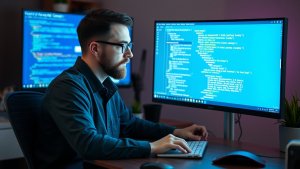
A man with glasses is working at a desk with dual monitors displaying code in a modern office setting.Why invest time learning Python? The job market reflects its utility. According to industry reports, Python consistently ranks as the most popular language on GitHub and Stack Overflow for enterprise adoption. Roles that specifically demand this skill include Data Analysts, Machine Learning Engineers, DevOps Specialists, and Back-End Developers.

Salaries vary by location, but in major hubs like New York or London, junior Python developers can expect starting salaries above $60,000 to $80,000 depending on experience. Remote work opportunities are also prevalent for Python developers because the code often runs on server infrastructure rather than local physical hardware. Furthermore, the language is portable; code written in Python on a Windows machine often runs on Linux or Mac servers with minimal changes.

Resources for Learning

There is no single "best" way to learn, but a combination of resources works best:

  • Official Documentation: Python's website (python.org) contains excellent tutorials.
  • Video Courses: Platforms like Coursera and Udemy offer structured paths. Look for courses with high ratings regarding community support.
  • Coding Communities: Join Discord servers or subreddits like r/learnpython to ask questions when you get stuck.
  • Challenges: Sites like CodeWars or LeetCode help practice algorithmic thinking, though these can sometimes be frustrating if used exclusively before understanding the logic behind the code.

Conclusion: The Journey Continues

A man with glasses works at a computer with code on one monitor and a screen displaying the Python logo in an office setting.Learning Python is not a sprint; it is a marathon that changes how you think about problem-solving. It teaches you to break complex challenges into smaller, manageable steps and automate solutions that would otherwise take hours of manual labor. As a beginner, your goal should be consistency over intensity. Code for 30 minutes every day rather than trying to cram for five hours once a week.

By the time you complete your initial study period, you will not just know Python; you will have developed computational thinking skills applicable to any technology stack. Whether you pivot into full-stack engineering, data analytics, or simply automate personal tasks like organizing files or sending automated emails, Python provides the tools. Your first program may look simple, but it represents a bridge from curiosity to capability. Start today, build your environment, and let the syntax become second nature. The digital future is written in code, and you have the key to read and write it.

Frequently Asked Questions (FAQs)

1. Do I need prior math knowledge to learn Python? No, while statistics help with data science later on, Python can be learned with basic arithmetic skills. Logic and problem-solving are more important than complex equations.

2. How long does it take to become job-ready? This depends on your goal. Basic proficiency often takes 1-2 months of dedicated study (5-10 hours a week). Advanced roles in AI may require a year or more of specialized training and practical project building.

3. Is Python hard for non-programmers? It is widely considered one of the easiest languages to read because its syntax resembles plain English. Concepts like loops and variables are intuitive once you understand the logic behind them.

4. Should I learn Java before Python? Not necessarily. Python is more modern in terms of syntax, and its large community provides more help for beginners. However, if you work in a specific enterprise environment where Java is dominant, learning Java first might be required. Otherwise, start with Python.