Download Corporate Calendar 2027 Download

 14 minutes
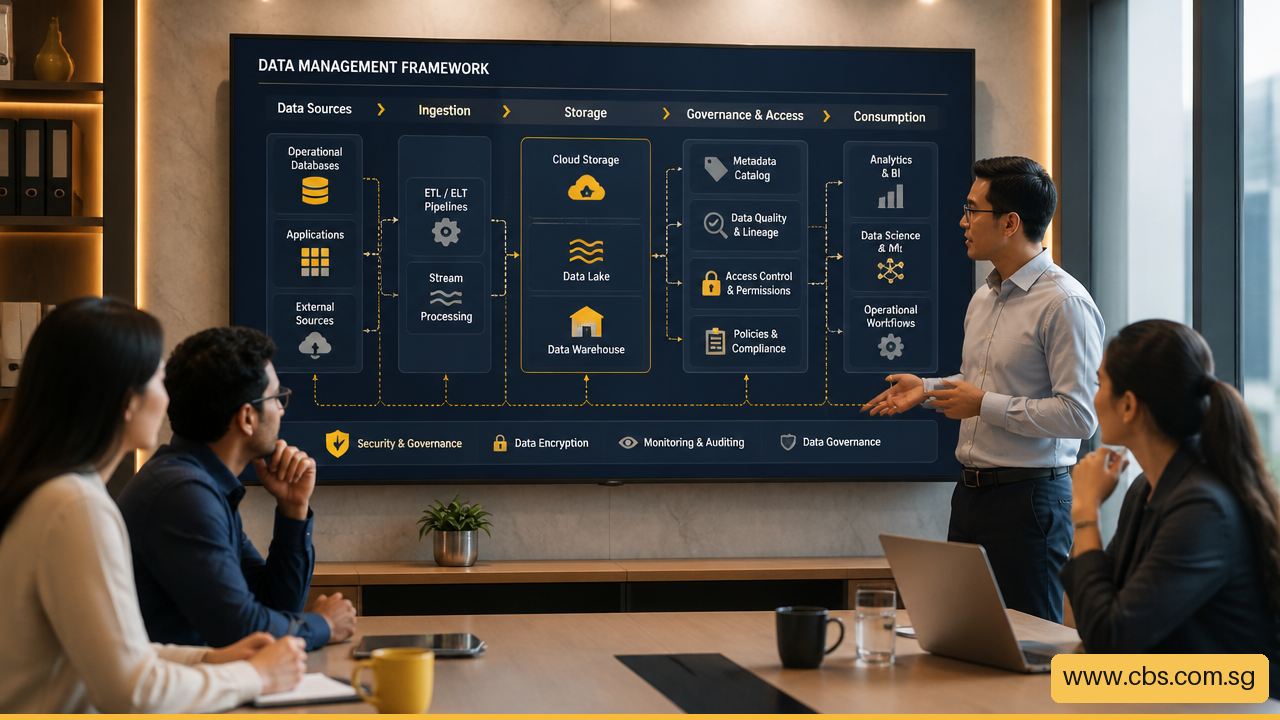
Data management is the disciplined way an organization creates, stores, protects, shares, uses, archives, and deletes data. I view it as a practical operating system for information: it helps people find reliable data, understand what it means, use it safely, and remove it when it no longer serves a valid purpose.
Poor data management rarely starts with a dramatic failure. It often begins with duplicate customer records, unclear spreadsheet ownership, old files in shared drives, or reports built from conflicting numbers. Over time, those small gaps can affect decisions, customer service, compliance, and incident response.
Table Of Contents
• Data management is broader than privacy compliance. It applies to personal data, financial data, operational records, product information, machine logs, analytics outputs, and more.
• Data governance sets decision rights. Data management turns those decisions into daily processes, technical controls, and usable records.
• A data inventory is the starting point for control. It should record where data sits, why it is used, who owns it, who receives it, and when it must be reviewed or deleted.
• Quality needs measurable service levels. A vague goal such as “improve data quality” does not identify which fields matter, what error rate is acceptable, or who must resolve defects.
• Retention is not just a calendar setting. Defensible deletion must account for legal holds, backups, replicated systems, test copies, extracts, and archives.
• Cloud providers and other third parties remain within the management boundary. Contracts, access records, security expectations, and deletion evidence all matter.
Data management is the umbrella discipline for handling data throughout its lifecycle. It includes data architecture, databases, cloud storage, metadata, integration, security, privacy, quality, master data management, reporting, retention, and disposal.
A useful distinction is simple:
Area | Main Question | Practical Output |
|---|---|---|
Data management | How will data be handled throughout its life? | Processes, tools, controls, records, and trained users |
Data governance | Who decides the rules and resolves conflicts? | Policies, roles, standards, approval paths, and accountability |
Data protection | How will personal data be handled lawfully and securely? | Privacy controls, notices, access processes, and breach response |
Data architecture | How will systems and data flows fit together? | Data models, integrations, storage patterns, and technical standards |
For example, governance may state that customer contact details must have a named owner and approved definition. Data management then puts that rule into action through validation checks, access controls, metadata, workflows, monitoring, and retention rules.
A report cannot be trusted merely because it looks polished. It must be traceable to defined data, known transformations, and accountable owners.
Singapore organizations should also avoid treating every data obligation as identical. Singapore’s private sector and public sector operate under different personal-data governance frameworks. Private-sector organizations commonly work within the Personal Data Protection Act, while public-sector data management is subject to separate statutory and administrative arrangements.
This distinction matters because an enterprise data strategy should cover more than personal data. Sales forecasts, equipment telemetry, inventory records, fraud indicators, and financial models may not be personal data, but they can still create material operational and security risks if inaccurate, exposed, or retained without control.
Every important dataset needs an accountable data owner. This is usually a business leader or function that can decide the dataset’s permitted use, quality expectations, access conditions, and retention needs. A data owner is not necessarily the system administrator.
A data steward supports daily control. The steward maintains definitions, metadata, quality rules, and issue records. In a customer-data domain, for instance, a sales operations manager may be the owner while a CRM operations specialist acts as steward.
I recommend assigning ownership by business accountability, not by whichever team hosts the database. IT can run infrastructure, but IT should not be forced to decide whether a customer identifier is valid for a marketing campaign or how long a business unit needs a contract record.
A workable ownership record should include:
• Dataset name and business purpose
• Named data owner and data steward
• Classification, such as public, internal, confidential, or restricted
• Approved users and access method
• Critical data elements and quality rules
• Retention schedule and disposal method
• Key downstream reports, systems, and recipients
There is no universal best governance model. The right choice depends on how centralized an organization is, how much its data domains overlap, and how quickly business teams need to make decisions.
Model | Best Fit | Main Strength | Main Risk |
|---|---|---|---|
Centralized | Smaller organizations or highly regulated environments | Consistent rules and strong oversight | Slow approvals and weak business ownership |
Federated | Larger organizations with shared enterprise data | Common standards with domain accountability | Requires mature coordination |
Domain-owned | Independent business units with specialized data | Faster local decisions | Conflicting definitions and duplicated controls |
A federated model is often practical when multiple teams share core entities such as customers, employees, suppliers, or locations. A central group can define minimum standards for classification, metadata, access, retention, and incident response. Business domains then manage definitions and quality rules that reflect their operations.
Fair warning: autonomy without common metadata creates a discoverability problem. A finance team may define “active customer” differently from sales, while both believe they are using the same metric. The result is not merely a reporting disagreement. It can affect forecasts, incentives, and strategic decisions.
For broader planning, a practical guide for data management can help teams connect governance concepts to workplace actions.
A data inventory is a structured register of datasets and processing activities. It is more useful than a simple system list because it describes the relationship between data, people, purpose, location, and lifecycle.
Start with business processes that create or use meaningful data: recruitment, sales, customer support, payroll, procurement, delivery, security monitoring, finance, and analytics. Then identify the systems, files, integrations, cloud services, reports, and third parties involved.
A practical inventory should capture the following fields:
Inventory Field | Why It Matters |
|---|---|
Dataset and system name | Identifies the asset clearly |
Data category | Distinguishes personal, financial, operational, or sensitive information |
Purpose of use | Tests whether collection and retention remain necessary |
Owner and steward | Establishes decision-making accountability |
Storage and processing locations | Supports access control, transfers, and incident response |
Recipients and third parties | Reveals external disclosure and processing paths |
Retention rule | Connects data to archival or deletion action |
Data lineage | Shows where data came from, how it changed, and where it went |
Do not wait for a perfect enterprise catalog. Begin with high-risk or high-value domains. A customer relationship management system, payroll platform, shared finance drive, and analytics environment often reveal the largest initial gaps.
The same inventory supports privacy obligations. The PDPC explains that Singapore organizations have operational duties for personal-data security, accuracy, access, correction, retention, and breach notification. Without an inventory, responding to an access request or assessing a potential breach becomes slower and less reliable because the organization cannot quickly determine what data exists or where it has traveled.
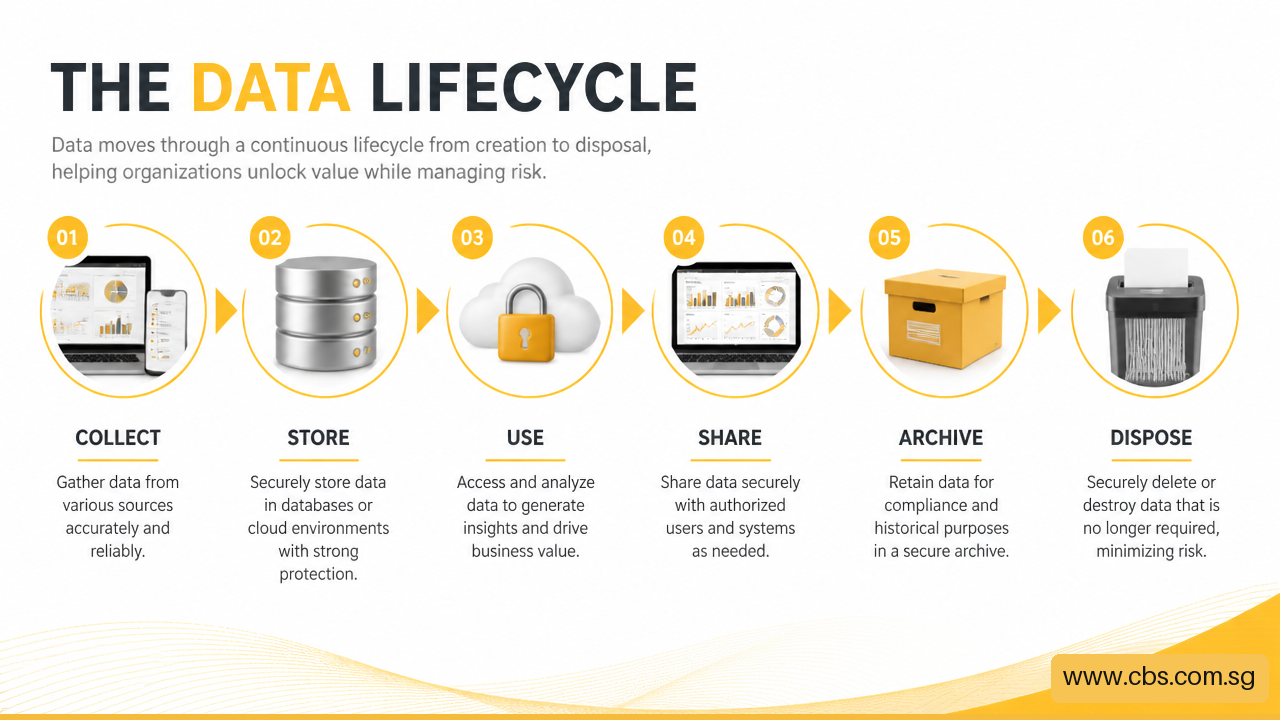
The data lifecycle commonly moves through creation or collection, storage, use, sharing, archival, and disposal. The key is to attach controls to each stage rather than treating lifecycle management as an abstract diagram.
The difficult cases are copies and derivatives. A customer extract may exist in a data warehouse, a manager’s spreadsheet, a sandbox environment, an email attachment, a backup, and a machine-learning test dataset. If only the source system is deleted, the organization has not necessarily completed disposal.
Retention needs a rule, an event, and evidence. The rule says how long data should be kept. The event starts the clock, such as contract expiry, account closure, last transaction, or employee departure. Evidence shows that the rule actually ran.
The PDPC states that organizations should stop retaining personal data when it is no longer needed for business or legal purposes. A practical retention schedule should therefore distinguish between active records, archives, backups, and copies held by external providers.
Consider a former customer’s records. The CRM may delete the active profile after the retention period, but nightly backups may still contain it. Immediate deletion from immutable backup media may be technically impractical. In that case, access should be tightly restricted, the backup should not be restored for ordinary use, and the record should expire through the normal backup rotation process. The rationale and expected deletion date should be documented.
A legal hold overrides routine disposal. When litigation, an investigation, or a regulatory matter requires preservation, the hold must reach all relevant copies, including archives, collaboration platforms, and employee devices where applicable. Once the hold ends, ordinary retention rules should resume.
Data quality means data is fit for its intended use. The common dimensions are accuracy, completeness, consistency, timeliness, validity, and uniqueness. But listing those words does not improve a database. Teams need measurable expectations for the fields and reports that matter most.
For example, an organization might define these service levels for a customer-contact dataset:
Quality Rule | Example Measure | Owner Response |
|---|---|---|
Valid email format | Percentage matching approved format rules | Correct or quarantine invalid records |
Unique customer identifier | Duplicate rate among active records | Merge, investigate, or create a survivorship rule |
Timely service status | Updates completed within agreed operating window | Escalate overdue updates to process owner |
Complete mandatory fields | Percentage with required contact and consent fields | Block incomplete entries where appropriate |
The exact thresholds depend on the decision being made. Payroll data and safety data generally need stricter controls than an optional event-preference field. There is no reliable universal error budget for every organization, so I recommend setting thresholds based on decision impact, volume, cost of remediation, and regulatory exposure.
When inaccurate data is discovered, avoid silently overwriting it. Log the issue, identify the root cause, correct affected records, and check whether the error flowed into reports, integrations, decisions, or disclosures. Data lineage makes that impact assessment much faster.
Security is not a separate layer added after data is collected. It is part of managing data responsibly. Classification determines how strongly data should be protected. Metadata makes sensitive data easier to find. Access logs help investigate suspicious activity. An inventory helps estimate the scale and impact of an incident.
The PDPC notes that a Data Protection Management Programme should link leadership accountability, resources, risk management, policies, impact assessments, training, and breach remediation.pdf). This is why a data protection program should not sit only with a legal or compliance function. It needs involvement from system owners, security teams, HR, procurement, and business leaders.
A basic breach-readiness workflow should include:
Singapore organizations must designate one or more people responsible for PDPA compliance. The PDPC’s Advisory Guidelines on Key Concepts in the PDPA describe this responsibility. The designated person should have clear authority to coordinate responses, not merely a title with no access to the relevant teams or records.
A cloud provider may host your data, but outsourcing infrastructure does not outsource accountability. Third parties can include software-as-a-service providers, payroll vendors, marketing agencies, managed service providers, call centers, analytics consultants, and data intermediaries.
Third-party controls should cover:
• The data categories and approved processing purposes
• Named access roles, authentication requirements, and logging
• Subcontractor approval or notification arrangements
• Security incident reporting and cooperation obligations
• Data return, deletion, and deletion-certification requirements
• Audit rights or other reasonable assurance mechanisms
• Cross-border storage or processing locations where relevant
Shadow data deserves equal attention. A spreadsheet downloaded for analysis can become an uncontrolled copy if it is emailed, placed on a personal drive, or reused months later. Simple rules help: give extracts an owner, label their sensitivity, restrict sharing, set an expiry date, and avoid putting live personal data into test environments unless it is necessary and adequately protected.
As organizations adopt automation and artificial intelligence, these controls become more urgent. Machine learning can help classify documents, detect duplicates, flag unusual access patterns, and identify data-quality anomalies. It can also create new copies, derived features, and opaque decision paths. Before using a dataset for model training or experimentation, record the purpose, source, access rules, retention period, and whether the output could reveal or reproduce sensitive information.
For teams developing modern capabilities, data management in 2026 offers a useful next step for connecting data controls with current technology practices.
Data management is the organized handling of data from creation through disposal. It combines people, rules, processes, and technology so data remains useful, accurate, secure, and available to approved users.
Data governance decides the rules, roles, and accountability. Data management applies those decisions through activities such as storing data, checking quality, controlling access, integrating systems, and deleting expired records.
Start with critical business processes and high-risk systems. For each dataset, record its purpose, owner, data categories, systems, locations, recipients, retention rule, classification, and major data flows. Expand the inventory in phases rather than waiting to map every low-value file first.
The owner should be the business function accountable for how the data is defined and used. A finance leader may own financial reporting data, while a customer service leader may own case-management data. Technical teams support the platform but should not automatically become business owners.
Prioritize the fields that affect decisions, compliance, payments, customer communication, or safety. Set clear validation rules, measure defects, assign remediation responsibility, and trace errors to their source process. Training in analytical methods can help staff interpret issues rather than simply clean symptoms; relevant data analysis courses can support that capability.
Retain data only while there is a valid business or legal need. Archive data when it must be preserved but does not need routine access. Delete or anonymize data after the retention period, unless a legal hold or documented requirement applies. Include backups and copied datasets in the process.
The PDPA focuses on personal data. However, non-personal business data can still require protection due to confidentiality, contracts, intellectual property, operational resilience, or sector-specific rules. A mature data-management program should govern both personal and non-personal information according to risk.
Maintain an inventory of the provider, data categories, processing purpose, access paths, hosting locations, subcontractors, retention terms, and incident-response contacts. Use contracts and operational reviews to confirm that the provider’s controls support the organization’s obligations.


https://www.cbs.com.sg/data-management-a-practical-framework-for-trusted-data/
copy

