Download Corporate Calendar 2027 Download

Download Corporate Calendar 2027 Download
 7 minutes
 Developing an effective AI agent requires not only technical proficiency but also a deep understanding of various disciplines including machine learning (ML), natural language processing (NLP), robotics, and more. As the field continues to grow, there is a growing demand for skilled professionals who can create intelligent agents that improve business efficiency, enhance customer experience, and drive innovation.
This comprehensive guide aims to equip you with the necessary skills required to excel in AI agent development. From programming languages to machine learning frameworks, we will cover everything from beginner-level knowledge to advanced concepts that are crucial for building cutting-edge AI solutions.

Programming languages play a fundamental role in AI agent development by providing the tools and syntax necessary to build intelligent systems. Here’s an overview of some popular programming languages used in this field:
Python: Widely considered the language of choice for AI, Python offers extensive libraries such as TensorFlow, PyTorch, Scikit-Learn, and Keras that simplify complex ML tasks like neural networks, data preprocessing, and model evaluation.
Java: Known for its versatility and scalability, Java is often used in enterprise-level applications where robustness and security are paramount. It also supports popular AI frameworks such as Deeplearning4j.
JavaScript: With the advent of Node.js and front-end frameworks like React and AngularJS, JavaScript has become an essential language for developing web-based intelligent agents that interact with users via browsers or mobile devices.
C++: This high-performance language is used extensively in robotics and real-time applications where speed and efficiency are critical. It provides access to lower-level system functionalities, making it ideal for developing AI-driven robotic systems and games.
Understanding these languages will help you choose the right tools for your project and enable you to write efficient, maintainable code that integrates seamlessly with other components of an AI ecosystem.
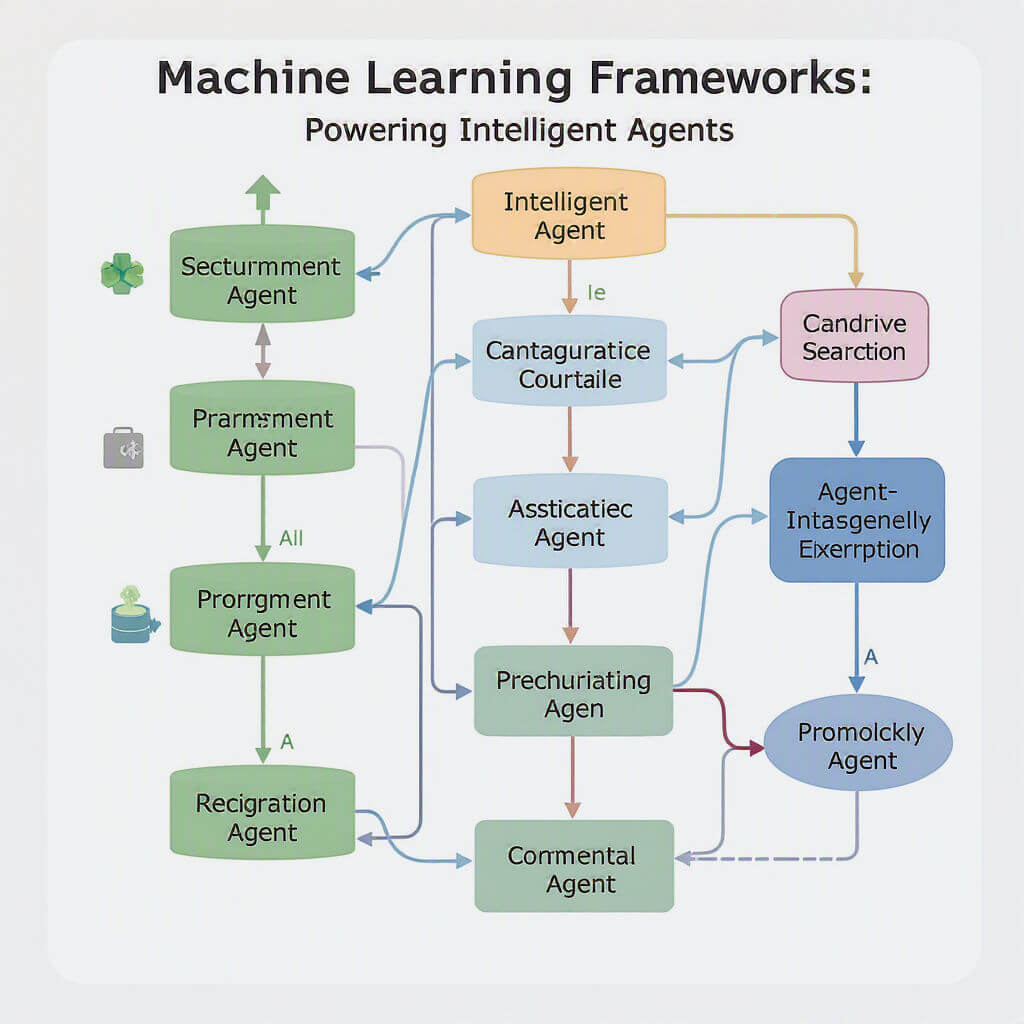
Machine learning frameworks are software platforms designed to simplify the process of developing and deploying ML models. They provide pre-built functions and utilities that help developers focus more on solving problems rather than reinventing wheels. Some widely used ML frameworks include:
TensorFlow: Developed by Google, TensorFlow is an open-source framework known for its flexibility and scalability. It supports both symbolic (static graph) and eager execution modes, making it suitable for research as well as production applications.
PyTorch: Created by Facebook’s AI Research lab, PyTorch emphasizes ease of use and dynamic computational graph generation. Its user-friendly interface makes it ideal for beginners while still offering advanced features like custom layers and CUDA support for GPU acceleration.
Scikit-Learn: Focused on traditional ML techniques such as regression, classification, clustering, and dimensionality reduction, Scikit-Learn is indispensable when working with structured datasets in Python.
Keras: Built on top of TensorFlow or Theano, Keras simplifies the creation of deep learning models through its high-level API. It allows rapid prototyping and easy experimentation without sacrificing performance.
Mastering these frameworks will empower you to build sophisticated AI agents capable of handling complex tasks ranging from image recognition to natural language understanding.
Natural Language Processing is a branch of AI that focuses on enabling computers to understand, interpret, and generate human-like text or speech. In the context of AI agent development, NLP plays a crucial role in building conversational interfaces, chatbots, voice assistants, etc.
Key components of an effective NLP system include:
Text Preprocessing: Tasks like tokenization (breaking down sentences into words), stemming (reducing words to their root form), and part-of-speech tagging are vital for preparing text data before feeding it into models.
Sentiment Analysis: This involves determining the emotional tone behind a series of words, commonly positive, negative, or neutral. It’s essential for gauging user feedback and improving agent responses.
Entity Recognition: Identifying named entities (people, organizations, locations) in text helps agents understand context and personalize interactions accordingly.
Dialogue Management: This involves keeping track of conversations, managing state transitions, and generating appropriate responses based on previous exchanges.
By leveraging NLP techniques, you can develop AI agents that not only recognize spoken or written words but also comprehend their meanings and nuances. This leads to more natural, engaging user experiences across various applications.
While many AI agents operate purely in digital realms (like virtual assistants), others need to interact directly with physical environments. These robotic agents use sensors and actuators to perceive and manipulate their surroundings effectively. Key areas of focus include:
Sensing: Utilizing cameras, microphones, ultrasonic sensors, etc., to gather environmental data.
Actuation: Controlling motors, grippers, wheels, etc., to perform tasks like moving objects or navigating spaces.
Localization and Mapping (SLAM): Simultaneous Localization And Mapping enables robots to build maps of their environment while maintaining an estimate of their location within that map.
Robotic AI agents are used in fields such as manufacturing, healthcare, exploration, and even entertainment. Developing these systems requires a blend of mechanical engineering knowledge alongside computer science skills, making it one of the most multidisciplinary aspects of AI development.
As AI technologies become increasingly ubiquitous, ethical considerations have risen to prominence. Developers must be aware of potential biases in training data, privacy issues related to collecting user information, and the broader societal impact of deploying intelligent agents without proper oversight.
Some key points to consider:
Data Anonymization: Removing personally identifiable information from datasets helps protect user privacy.
Transparency: Providing clear explanations for AI decisions builds trust with users.
Accountability: Ensuring that there are mechanisms in place to hold developers and organizations accountable if their systems cause harm.
Addressing these ethical challenges is crucial not only for legal compliance but also for fostering public acceptance of AI technologies over the long term.

The demand for skilled professionals capable of developing intelligent agents continues to grow exponentially across industries. According to a report by Grand View Research, the global market for AI in robotics is expected to exceed $25 billion by 2030. This presents immense opportunities for those willing to invest time and effort into mastering the art of building smart systems.
Potential career paths include:
AI Developer: Focused on designing and implementing machine learning algorithms tailored specifically towards creating intelligent agents.
Robotics Engineer: Combines knowledge from mechanical engineering, electrical engineering, and computer science to design robots capable of performing real-world tasks autonomously or semi-autonomously.
NLP Specialist: Specializes in developing natural language processing systems that enable computers to understand human speech and text effectively.
Each role comes with its unique set of challenges and rewards, making AI agent development a dynamic and exciting field ripe for innovation.
Becoming proficient at developing intelligent agents requires a combination of technical expertise, theoretical knowledge, and practical experience. By mastering programming languages, machine learning frameworks, natural language processing techniques, robotics concepts, ethical guidelines, and understanding the broader career landscape, you can position yourself as a valuable asset in this rapidly evolving field.
Remember that staying updated with new advancements is key to remaining competitive in AI development. Continuous learning through online courses, workshops, and hands-on projects will equip you with the skills necessary to build innovative solutions that shape our future.
With dedication and passion, anyone can embark on this journey towards becoming a skilled AI agent developer and contribute significantly to shaping smarter technologies for tomorrow’s world.


https://www.cbs.com.sg/mastering-ai-agent-development-essential-skills-and-tools-for-building-intelligent-agents/
copy

