Download Corporate Calendar 2027 Download

 13 minutes

AI problem-solving skills are the ability to define a problem clearly, use artificial intelligence to explore possible solutions, test the output against evidence, and remain accountable for the final decision. I would treat AI as a thinking partner, not an authority. It can accelerate research, analysis, drafting, and prototyping, but it cannot reliably decide what matters most in a real situation without human judgment.
A useful AI workflow does not begin with a clever instruction. It begins with a clear problem, known constraints, reliable information, and a plan for checking the result. That distinction matters whether you are a student assessing sources, a manager improving a process, or a team designing a new service.
• What AI Problem-Solving Skills Include
• A Reliable AI Problem-Solving Workflow
• Choosing the Right Level of AI Involvement
• Key Takeaways
• Frequently Asked Questions
• Sources And References
AI problem-solving skills combine human reasoning with machine-supported analysis. They are broader than prompt writing. A prompt may start a conversation with a generative AI system, but problem solving requires you to decide what question deserves answering, what evidence is needed, what risks are acceptable, and whether the proposed answer can work in practice.
Nanyang Technological University’s AI for Problem Solving programme describes this capability as a combination of computational thinking, structured reasoning, generative AI use, verification, and workplace application. That is a helpful definition because it places AI output inside a wider decision process.
A common mistake is to confuse task decomposition with prompt decomposition.
Task decomposition means breaking the real problem into work that must be completed. For example, a customer-service team facing repeated complaint delays may need to:
Prompt decomposition is different. It means deciding which AI request is appropriate for each task. One request might classify complaint themes. Another might summarize policy documents. A third might produce a draft workflow diagram. The AI should not be asked to solve the entire business problem in one unsupported leap.
A strong AI-assisted solution is traceable: you should be able to show the inputs, assumptions, evidence, revisions, and human decisions behind it.
AI can generate options quickly, but it does not remove the need for human skills. I would prioritize the following capabilities before advanced tool features:
Skill | What It Means In Practice | Why It Matters |
|---|---|---|
Problem framing | Defining the outcome, scope, stakeholders, and constraints | Prevents AI from optimizing the wrong objective |
Root-cause analysis | Looking beyond visible symptoms | Reduces the risk of automating a flawed process |
Evidence evaluation | Checking claims against trustworthy records and sources | Helps detect fabricated or unsupported outputs |
Judgment under uncertainty | Recognizing what is unknown or ambiguous | Stops false confidence from becoming a decision |
Communication | Explaining recommendations, limits, and trade-offs | Makes AI-supported work reviewable by others |
Ethical reasoning | Considering privacy, bias, harm, and accountability | Protects people affected by the decision |
The University of Pittsburgh notes that strategic problem solving requires decomposition, root-cause analysis, assumption testing, and multi-step solution design. These are not secondary skills. They determine whether AI use improves a decision or merely makes a weak decision happen faster.
AI systems work from patterns in data and instructions. They do not automatically know your organization’s policy, your customer’s needs, or the consequences of a wrong answer. Before requesting help, provide the details that change the answer.
Useful context often includes:
• The desired outcome and how success will be measured
• The audience, stakeholders, and decision owner
• Known facts, source materials, and missing information
• Constraints such as budget, time, law, policy, privacy, or safety
• Options already considered and reasons they may not work
• The required output format, such as a decision memo, table, process map, or draft response
For example, “Suggest ways to improve employee onboarding” is broad. “Create three onboarding workflow options for a 50-person Singapore office, with a two-week completion target, no new software budget, and a manager review step” is more useful. The second request gives AI boundaries. It also gives a human reviewer something concrete to assess.
A repeatable process is more dependable than repeatedly rewriting one long request. I recommend treating AI-assisted work as a sequence of decision gates. Each gate asks whether the next step is safe, supported, and useful.
Start with a short problem statement:
We need to decide X for Y group by Z date, while meeting A, B, and C constraints.
Then identify what type of problem you have. Is it a research question, a writing task, a process design issue, a forecasting question, a technical diagnosis, or a people decision? AI may be useful in each case, but the evidence standard is different.
A policy summary can often be reviewed against the source document. A hiring recommendation, medical question, legal interpretation, or security response needs much closer oversight because an error could affect rights, safety, money, or compliance.
Evidence traceability means preserving the basis for a result. Instead of asking AI to provide an answer with no audit trail, ask it to separate facts, assumptions, uncertainties, and recommendations.
A practical request structure can include:
For example: “Using only the attached meeting notes, identify recurring operational bottlenecks. Separate direct evidence from assumptions. Do not infer causes without support. Provide three possible interventions and list what data would be needed to test each one.”
This does not guarantee accuracy. It does make unsupported leaps easier to see.
Generative AI is often effective for producing multiple ways to approach a problem. It can help summarize information, map a workflow, draft a chatbot outline, or create an initial prototype. NTU describes these practical applications as including problem analysis, workflow design, information synthesis, chatbot development, and rapid prototyping.
Consider a Singapore-based facilities team trying to reduce repeated maintenance requests. AI could sort request descriptions into categories, identify recurring wording, and draft a triage workflow. A human team should still confirm whether the categories match actual building conditions, whether resident data is handled appropriately, and whether the proposed workflow fits existing service rules.
This is where AI automation and business efficiency becomes a practical question rather than a technology slogan. Automation should follow a stable, tested process. If the process is unclear, AI may scale confusion instead of reducing it.
“Check the output” is too vague for serious work. Use a verification protocol that matches the consequences of error.
Check | Question To Ask | Example Recovery Step |
|---|---|---|
Accuracy | Does the claim match the supplied evidence or authoritative record? | Compare it with the original document or data source |
Completeness | What relevant facts, stakeholders, or constraints are missing? | Ask for a gap analysis before proceeding |
Logic | Does the recommendation follow from the evidence? | Challenge each conclusion and request reasoning |
Calculation | Can numbers, dates, and formulas be reproduced? | Recalculate independently using a spreadsheet or approved tool |
Bias | Could the output unfairly favor or disadvantage a group? | Review criteria and remove irrelevant personal factors |
Compliance | Does the recommendation create privacy, policy, or legal concerns? | Escalate for specialist review before implementation |
I would also set an error budget. A spelling error in an internal brainstorming note may be tolerable. An incorrect tax calculation, safety instruction, student assessment, hiring score, or security recommendation may not be. The lower the acceptable error budget, the more independent review is required.
Keep a short record for high-impact work:
• The original problem and decision owner
• Inputs and source documents used
• Major assumptions and unresolved questions
• AI outputs that influenced the decision
• Verification steps completed
• Final human approval and implementation result
This record is not bureaucracy for its own sake. It helps teams learn which assumptions failed and which prompts produced useful evidence. It also supports accountability when someone later asks, “Why was this decision made?”
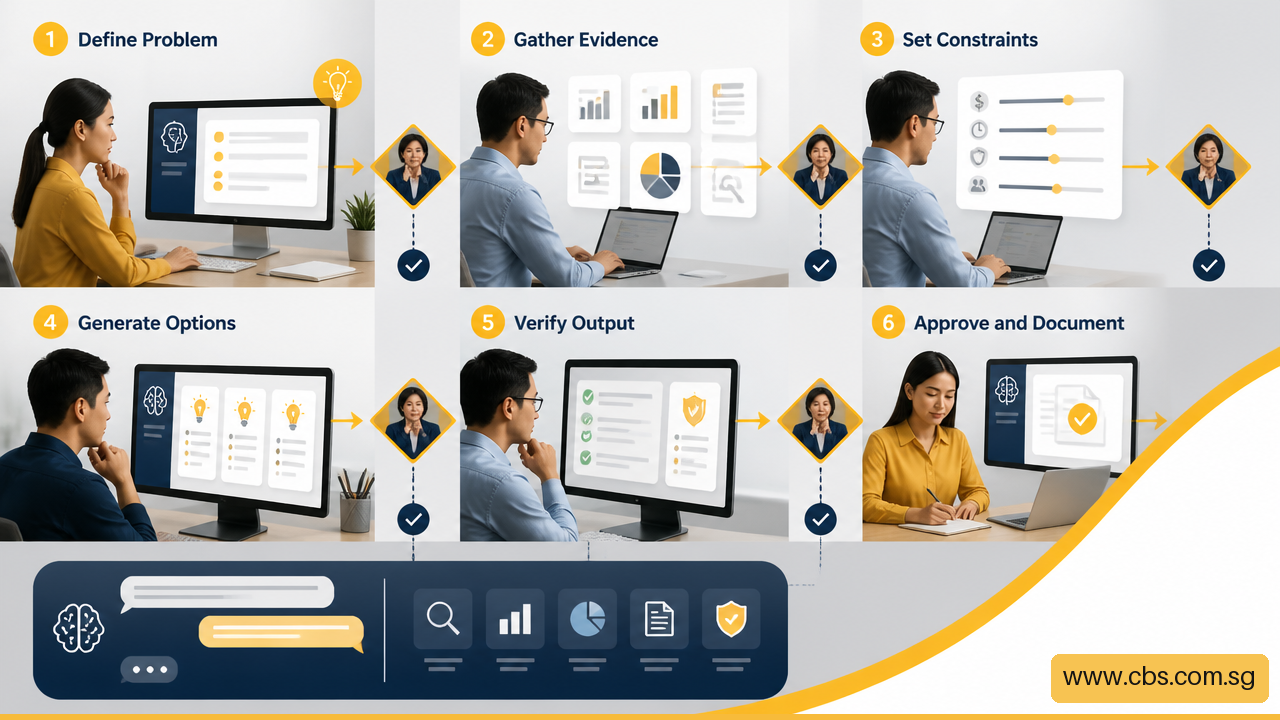
Not every task needs the same AI role. The best approach depends on risk, ambiguity, available evidence, and the cost of a wrong answer.
Mode | Best Used When | Main Benefit | Main Risk |
|---|---|---|---|
Human-only | The task is highly sensitive, poorly defined, or dependent on confidential judgment | Strong contextual control | Slower analysis and fewer explored options |
AI-assisted | A person owns the decision while AI supports research, drafting, classification, or comparison | Faster preparation and broader alternatives | Users may accept plausible output too quickly |
AI-orchestrated | A repeatable workflow has defined inputs, tests, approvals, and exception handling | Greater scale across routine steps | Errors can spread quickly if controls are weak |
AI orchestration means coordinating tools, people, data, review gates, and workflow stages around a goal. It is not simply asking one chatbot to do more. For example, a team might use one system to classify incoming requests, another to draft responses from approved knowledge, and a human reviewer to approve exceptions.
Choose AI-assisted work when the task benefits from speed but still requires interpretation. Choose AI orchestration only after the underlying process is stable and there is a clear owner for failures. Avoid delegating final decisions to AI when the task involves sensitive personal data, disciplinary outcomes, high-stakes assessments, emergency action, or unclear authority.
Sometimes the main problem is not lack of ideas. It is lack of facts, agreement, or authority.
Do not begin with AI when:
• The decision requires confidential information that cannot be safely shared with the selected system
• The team has not agreed on the actual problem
• Source data is incomplete, outdated, or unreliable
• A person with legal, clinical, financial, security, or regulatory responsibility must make the judgment
• The consequences of an error are serious and no verification route exists
Fair warning: AI may still provide a fluent answer in these cases. Fluency is not proof.
Teams get better results when they divide review roles. One person can frame the problem, another can check facts, and a decision owner can assess trade-offs. This reduces the chance that one confident but unsupported AI output becomes the team’s shared assumption.
Improving team collaboration with AI tools can be especially useful when a group needs to consolidate notes, compare viewpoints, or maintain a shared action list. The key is to make the review process visible. AI can summarize disagreement, but people must resolve it.
AI can also support stakeholder communication by helping teams draft plain-language explanations, prepare meeting questions, and identify likely misunderstandings. For more on this application, see AI technology in communication.
The strongest AI problem-solving skills are not about getting an answer quickly. They are about setting up a process where a useful answer can be tested.
• Define the real decision before writing an AI request.
• Break the work into tasks, evidence needs, and review points.
• Require AI to distinguish facts from assumptions and uncertainties.
• Match verification effort to the potential cost of an error.
• Keep a decision record for high-impact work.
• Use human accountability for final judgments, especially where people, safety, rights, money, or compliance are affected.
Singapore education discussions make this principle clear. Berita Harian reports that students are encouraged to test AI-answer accuracy, assess source trustworthiness, and remain responsible for their final work. The same standard applies at work: AI can contribute to the process, but accountability cannot be outsourced.
AI problem-solving skills combine problem definition, decomposition, data analysis, prompt design, verification, ethical judgment, and communication. They help you use AI to explore and test possible solutions without treating generated output as automatically correct.
No. Prompt engineering is one part of interacting with AI. AI problem solving is broader because it includes deciding what problem to solve, gathering evidence, setting constraints, comparing options, testing outputs, and implementing a decision responsibly.
Check whether it matches your source material, follows the stated constraints, makes logical sense, and can be independently verified. For calculations, reproduce them. For factual claims, check authoritative records. For recommendations, ask what assumptions would make the answer fail.
Stop treating confidence as evidence. Identify the specific claim that is wrong, compare it with reliable information, correct the context or instructions, and ask the system to separate verified facts from uncertain conclusions. If the task is high impact, escalate it to the appropriate human reviewer.
There is no proven ideal number. Refine until the output meets the stated requirements and the remaining uncertainty is acceptable for the task. Coursera’s overview of AI skills notes that AI-assisted problem solving commonly requires iterative refinement because an initial response may be incomplete. For a low-risk draft, one revision may be enough. For a policy, financial, or safety-related decision, the focus should be independent validation rather than more wording changes.
Use AI for brainstorming when you need a wide range of ideas, alternative wording, possible risks, or early workflow options. Keep final decisions with accountable people when trade-offs affect budgets, employees, customers, students, safety, or compliance.
Students can first attempt the problem independently, then use AI to compare approaches, explain a concept, identify gaps, or challenge reasoning. They should be able to explain the final answer, defend the sources used, and show how they checked any AI-generated claims.
Do not delegate final decisions involving confidential personal data, high-stakes assessments, medical or legal judgments, disciplinary actions, emergency responses, or situations where evidence is unavailable and the cost of error is high. AI may assist with preparation, but it should not become the unreviewed decision maker.


https://www.cbs.com.sg/ai-problem-solving-skills-a-practical-guide-to-better-decisions/
copy

