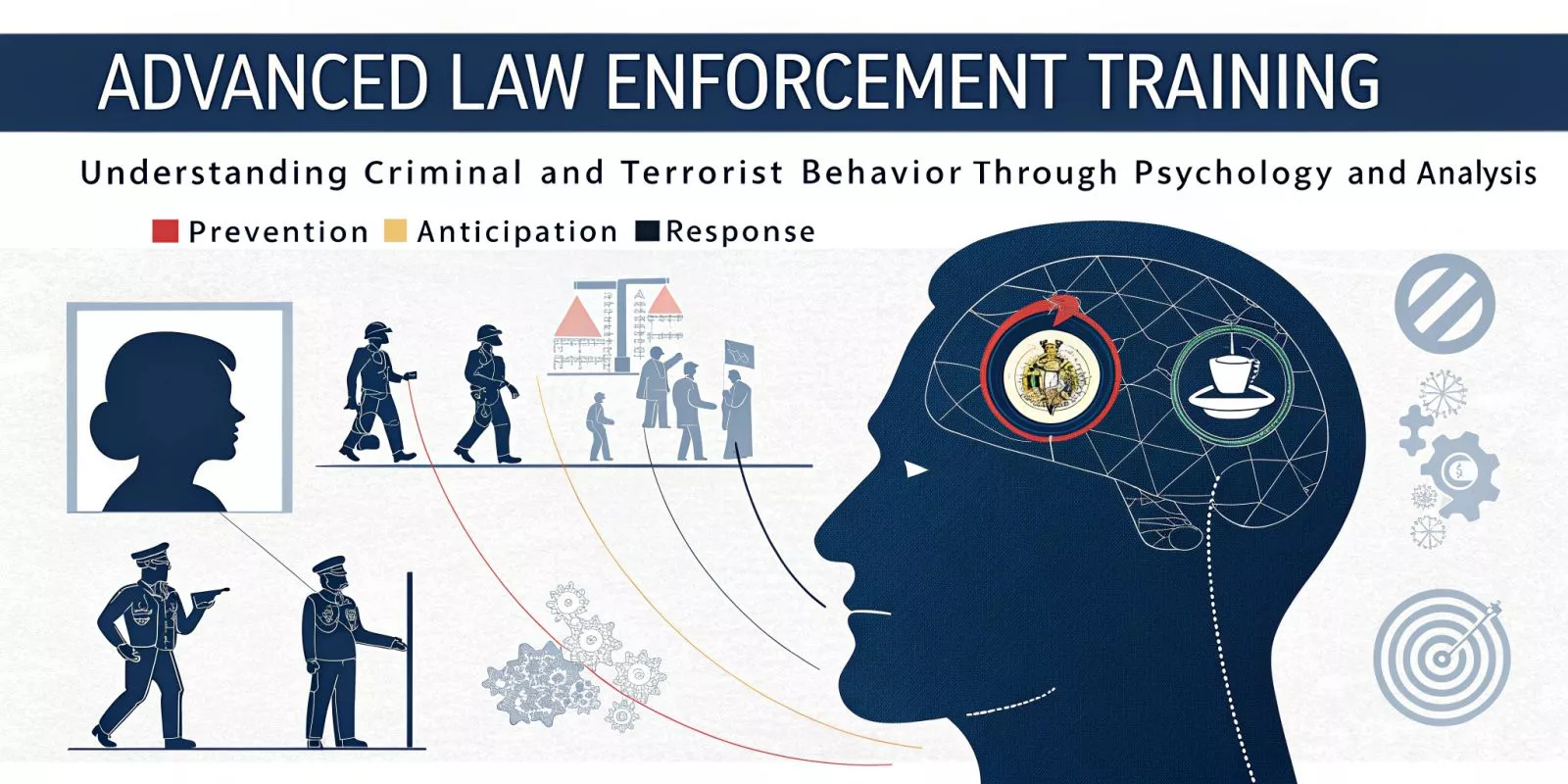
Inside the Criminal and Terrorist Mind: Applied Criminal and Forensic Psychology for Modern Law Enforcement

Understanding Offender Psychology to Anticipate, Prevent, and Respond

This course is a highly immersive 2-day professional training designed for law enforcement and public safety and security practitioners seeking to strengthen their analytical and decision-making capabilities. Grounded in criminology, criminal and forensic psychology, this course examines why individuals offend, escalate, radicalise, and persist in crime, and how these insights can be applied directly to investigation, prevention, and rehabilitation. Participants will explore the criminological and psychological drivers of criminal and terrorist behaviour, offender decision-making under pressure, and behavioural patterns relevant to profiling and risk assessment. Through real-world case studies drawn from Singapore and global contexts, the course bridges theory and practice across policing, corrections, counterterrorism, and community-based supervision.

The programme emphasises experiential learning. Participants will engage in scenario-based problem solving, behavioural analysis exercises, and structured discussions where they “think like an offender” and apply the lens of a criminal and forensic psychologist. Overall, this course equips professionals with knowledge to enhance operational effectiveness, ethical judgement, and inter-agency collaboration in today’s complex crime and security landscape.

Learning Outcomes

By the end of the workshop, participants will be able to:

  • Explain key criminological and psychological theories underpinning criminal and terrorist behaviours.
  • Differentiate between opportunistic, instrumental, expressive, and ideologically-motivate offending.
  • Apply criminological and psychological insights to investigation, risk assessment, profiling and prevention.
  • Evaluate rehabilitation and reintegration strategies from a public safety and security perspective.
  • Reflect critically on ethical boundaries and the limitations of criminal and terrorist profiling.
Course Outline

1) Foundations in Criminology – Causes of Crime

  • Biological, psychological, social and situational causes of crime
  • Rational choice versus emotional/expressive offending
  • Strain, social learning, control and opportunity perspectives

2) Foundations in Criminal & Forensic Psychology

  • What is criminal psychology?
  • What is forensic psychology?
  • Psychology’s role in policing, corrections, and security

3) Profiling Criminal and Terrorist Mindset and Behaviour

  • Characteristics of criminal and terrorist mindsets
  • Individual versus group dynamics
  • Radicalisation pathways

4) Crime Prevention and Counterterrorism

  • Global crime prevention theories
  • Countering violence extremism and terrorism
  • Deterrence, displacement, and unintended consequences

5) Offender Rehabilitation and Reintegration

  • Strengths and limitations of punishment
  • Desistance, compliance, and behavioural change
  • Community reintegration and supervision challenges

6) Case Study Discussion

  • Case-based discussion (local + global)
  • Scenario analysis and small-group profiling exercises
  • Ethical dilemma debates
Training Methodology
    Series of presentation and discussion
  • Discussion of real-world case studies/scenarios
  • Interactive group activities
Who Should Attend
  • Police and law enforcement officers.
  • Prison, correctional, and probation officers
  • Child protection officers
  • Psychologists, counsellors and social workers working with offenders; other community care and aftercare professionals in the offender rehabilitation sector
  • Anyone from the public safety and security sector who is keen to equip themselves with applied knowledge to enhance their professional work
Testimonials

“Anil is very experienced facilitator who in-depth knowledge on Criminology, Criminal and Forensic Psychology. His forte is presenting abstract concepts and theories in lay language, and provide practical examples and approaches for easy learning.”

“Subject content was relevant and useful. I benefited from Anil’s background knowledge of the subject and his vast experience in dealing and manging offenders and their families in the rehabilitation journey.

“The course was engaging, insightful and thought-provoking. In particular, case-based discussion were useful to reinforce the learning and relate to my professional work.”

About the Trainer

A man in a black suit is seated against a dark background, smiling at the camera.

Mr Anil Singh

Specialist in Criminal, Forensic, and Crisis Psychology
(Master of Social Sciences, National University of Singapore)

Anil Singh is a Senior Associate Lecturer, Trainer, and Academic Coach with over a decade of experience working across government agencies, enforcement-linked institutions, and community organizations. With a strong foundation in psychology, sociology, and public safety, Anil specializes in understanding criminal behavior, radicalization, crisis dynamics, and high-risk decision-making.

Before moving into full-time lecturing and training, Anil served as Community Outreach Manager at the National Addictions Management Service (NAMS), Institute of Mental Health (IMH), and later as Executive Director of a community drug rehabilitation center, where he worked closely with offenders, at-risk individuals, and crisis cases. These roles gave him direct exposure to the behavioral patterns, motivations, and psychological triggers behind criminal activity, substance abuse, and violence.

Anil holds a Master of Social Sciences from the National University of Singapore, along with professional certifications in adult education and counseling. His training approach blends applied criminal and forensic psychology with real-world case analysis, enabling law enforcement professionals to better assess threats, recognize behavioral red flags, understand extremist and criminal mindsets, and respond effectively under pressure.

Known for his engaging, practical teaching style, Anil equips modern law enforcement officers with actionable psychological insights to enhance investigation, prevention, interrogation awareness, and crisis response—bridging theory with operational realities on the ground.